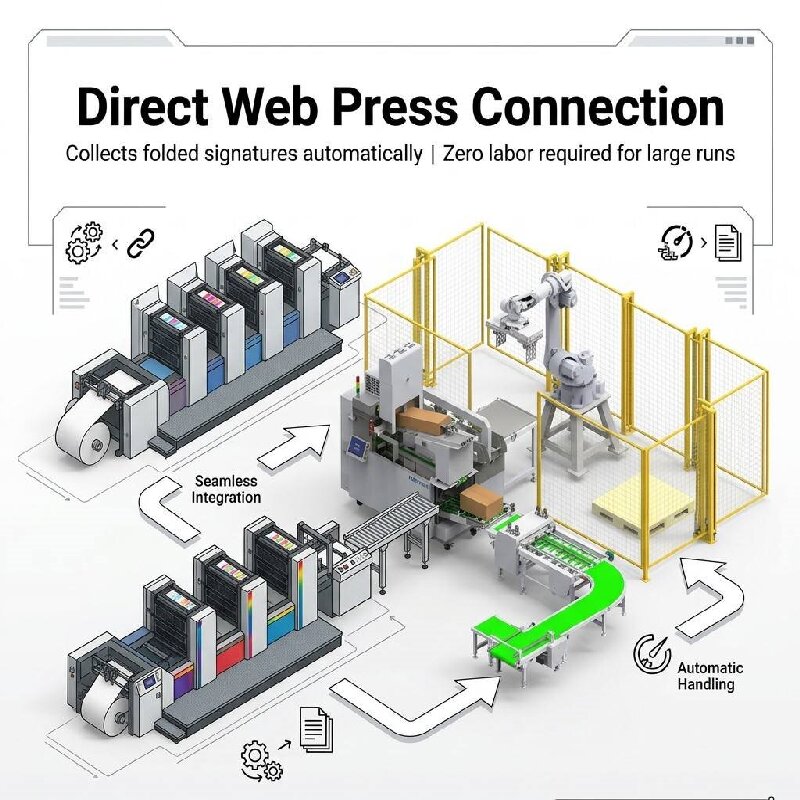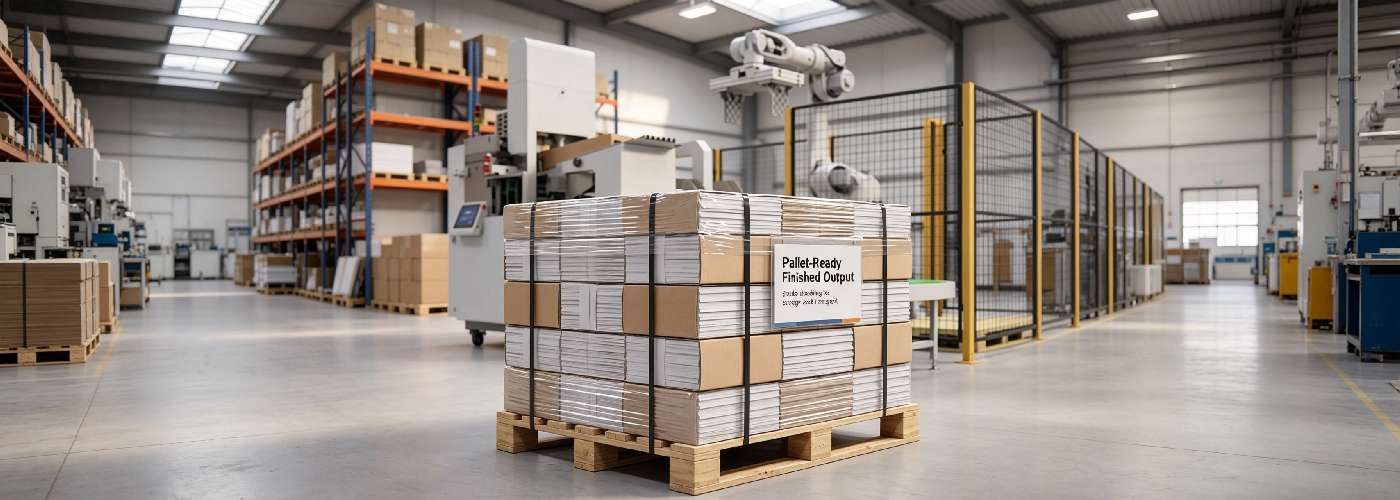
HX40000W Web Press Signatures Collecting Bundling Palletizing System is the fully automatic delivery for large runs folding signatures production, no laborer required, completely the intelligent automatic folding process.
|
Walk behind any web press running at full speed and you will see the industry's most expensive bottleneck hiding in plain sight: workers catching folded signatures by hand, stacking them, squaring them, banding them, and lifting them onto pallets. It looks normal because every printer has done it for decades. But run the numbers on what that crew actually costs versus what a Web Press Signature Bundling System costs, and the comparison is not even close.
What Manual Signature Collection Really Costs Per Shift A modern high-speed web press producing 30,000 to 40,000 signatures per hour typically requires two to four workers at the delivery end just to keep up. At a fully loaded labor cost of roughly 25,000 to25,000 to 40,000 per worker per year, a three-person crew costs 75,000 to75,000 to 120,000 annually. Over five years, that is up to $600,000 in direct labor expense for a single web press. Then add the hidden costs. Overtime when the press runs late. Temporary workers during peak season. Workers' compensation claims from repetitive lifting. Supervisory attention that manual collection demands. The true all-in cost is typically 30 to 40 percent higher than the visible payroll number.
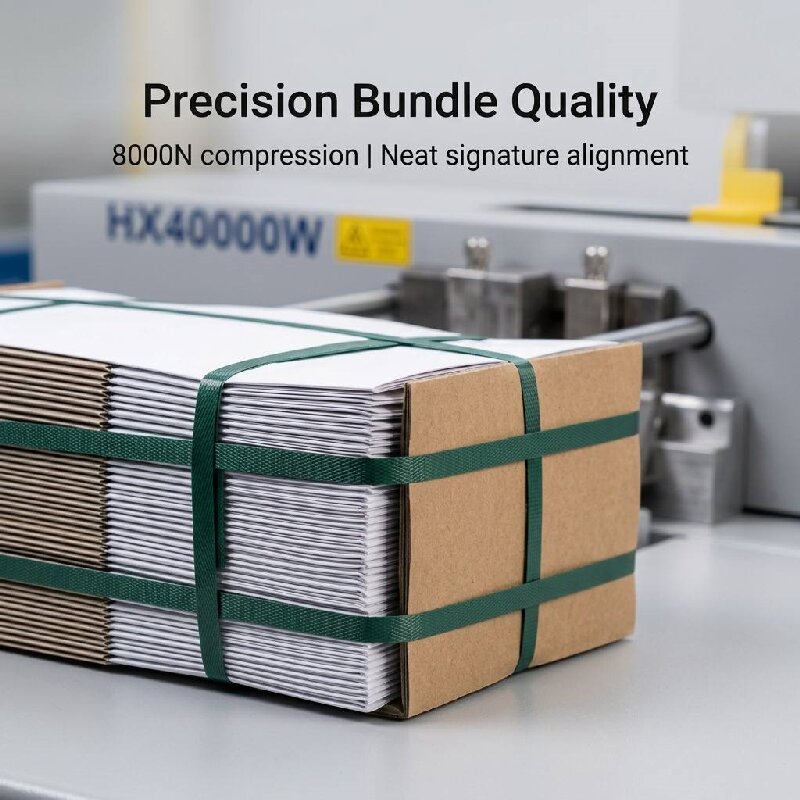
Manual collection also creates waste. A fatigued worker places one misaligned signature in a stack, and the entire bundle goes into the binder crooked. A bundle dropped during transport shifts half the signatures out of alignment. These failures mean reprinted material and slipped schedules—typically 1 to 3 percent of total output on a press producing 30 million signatures per year. What an Automatic System Delivers for a One Time InvestmentAn automatic signature bundling system replaces the delivery crew with an integrated line. The system connects directly to the web press delivery, collecting signatures vertically as they exit the folder. Fapping arms square each stack continuously. At the programmed height—typically 500 to 700mm—the stack transfers to the bundling station. Clapboards insert at both ends. An 8,000 Newton compression force binds the stack into a perfectly square, transport-ready bundle. No one touches a signature. No one lifts a bundle. A system like the HX40000W illustrates the capability. With a maximum speed of 40,000 pieces per hour, it keeps pace with the fastest web presses without slowing down, taking breaks, or making mistakes. The signature size range—210mm to 460mm, in 16K or 32K formats, across 60 to 120gsm paper—covers the full commercial and educational publishing spectrum.
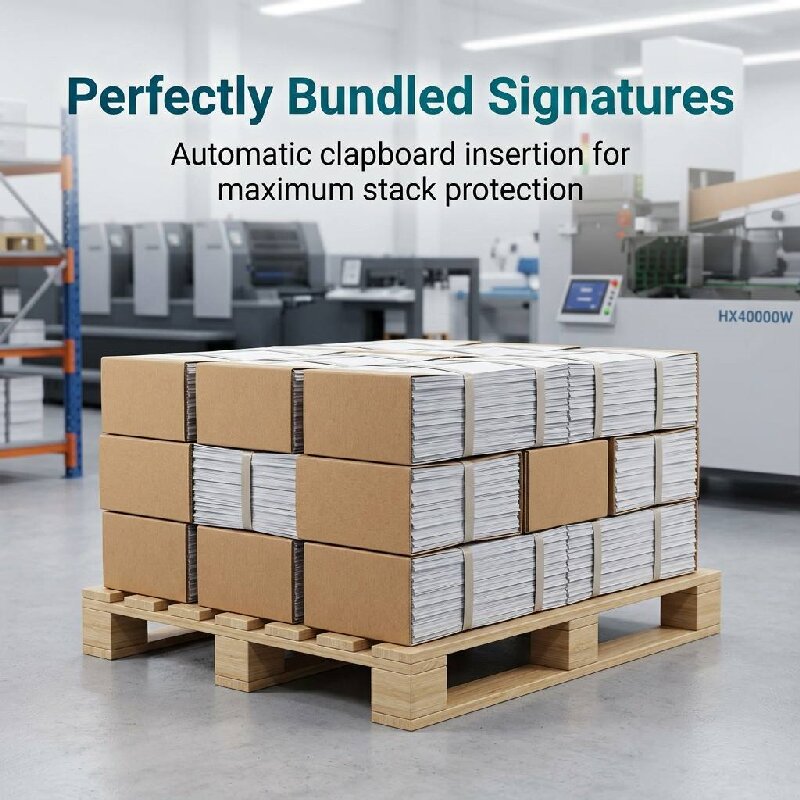
The 8,000 Newton bundling pressure combined with automatic clapboard insertion at both ends creates bundles that are not just bound but structurally rigid. The clapboards protect the top and bottom signatures from handling damage during palletizing and transport. Calculating the Payback PeriodThe payback calculation for a bundling system is one of the cleanest ROIs in printing equipment because the cost being replaced is recurring labor. Consider a single web press running two shifts per day. Before automation, the delivery end needs four workers per shift to handle 40,000 signatures per hour: two collecting, one banding, one palletizing. That is eight workers across two shifts. At 35,000perworkerperyear,annuallaborexpenseis35,000perworkerperyear,annuallaborexpenseis280,000. After installation, the delivery end requires zero dedicated workers. The system handles collection, squaring, bundling, and discharge autonomously. At a purchase price of roughly 250,000 to 250,000 to 400,000 for a professional system, the payback period is 11 to 17 months. Over a conservative 10-year operating period, net savings exceed $2.4 million from a single web press line—and that excludes waste reduction, lower insurance premiums, and the output gains from eliminating delivery-end bottlenecks. Hidden Costs That Only Appear on Two Shift OperationsAny manual process runs differently at hour one and hour eight. By the sixth hour of a shift, fatigue sets in. Stacking motions slow. Alignment errors increase. The press operator begins slowing the press—not because the press cannot run faster, but because the human delivery system cannot keep up. This press slowdown represents lost production that is rarely attributed to the delivery process but is directly caused by it. Second-shift dynamics compound the problem. Evening crews are often less experienced. Absenteeism is higher, forcing supervisors to run short-staffed. These inefficiencies accumulate across months, creating an output deficit that management blames on "normal production variance." An automated system eliminates these variables. It runs at 40,000 pieces per hour at 9 AM and at 9 PM. It does not slow down, call in sick, or make alignment errors at the end of a long shift. The web press captures its full rated capacity, every shift.
Why Clapboard Insertion Beats Manual BandingClapboard insertion separates serious automation from basic bundling. In manual operation, exposed top and bottom signatures are vulnerable to every handling event. The bottom signature rubs against the pallet. The top signature bears the weight of the upper bundle. Forklift movement shifts the outermost signatures. Clapboards—typically 8 to 12mm thick—act as structural faces that absorb handling forces and protect the paper inside. The 8,000 Newton bundling pressure compresses the entire stack, including the clapboards, into a rigid unit that stacks, transports, and stores without the damage that plagues banded-only bundles. Bindery operators see the difference immediately: clean, square edges and undamaged signatures instead of scuffed corners and shifted stacks. What the System Requires from Your FacilityAutomating the delivery end is less demanding on your infrastructure than maintaining a manual crew. A system like the HX40000W runs on standard three-phase 380V drawing 6.5 kilowatts—comparable to a small industrial air conditioner. The pneumatic system needs a 6 bar compressed air supply, which most web press facilities already have. The footprint of about 3 meters by 0.95 meters by 2.55 meters tall fits at the press delivery end without major layout changes, and the 2,000kg machine weight sits securely on a standard industrial floor. The feeding height adjusts between 300 and 520mm to align with your press delivery. Contrast that with the infrastructure of a manual crew: locker rooms, break areas, parking, HR administration, payroll processing, safety training, and supervisory overhead. The real infrastructure cost of manual collection is not measured in kilowatts but in everything a facility must provide to support a human workforce. Common Objections and Why They FailThe most frequent objection is reliability: "If the machine breaks down, the press stops." But modern bundling systems use proven industrial components—pneumatic actuators, PLC controls, conveyor drives—with decades of reliability history. Routine maintenance takes minutes during planned downtime. Unscheduled breakdowns are rare when equipment is properly maintained. The second objection is flexibility. What if a customer wants a non-standard bundle? Modern systems address this with programmable controls. The operator sets bundle thickness within the 500 to 700mm range, clapboard parameters, and bundling pressure through the control interface, not through mechanical modification. The third objection is upfront cost. But as the payback calculation shows, the return begins in the first year and compounds for the life of the machine. Deferring the purchase to save capital this quarter costs far more in ongoing labor than the purchase itself costs as a one-time investment. The Decision That Eventually Makes ItselfNo printer installs an automatic bundling palletizing system because manual collection has stopped working entirely. They install it because the manual model has become too expensive, too unreliable, and too hard to staff. The numbers rarely lie: if your delivery crew costs $200,000 or more per year, an automatic system paying for itself within 18 months is not a luxury—it is the cheaper option over any realistic planning horizon. The only real question is whether you want the savings to start this year or next. |
| Tag:robot,web press,folding machine,bundling machine |
Please Leave Your Messenger Here!
We will do our best to make your business prosperous!


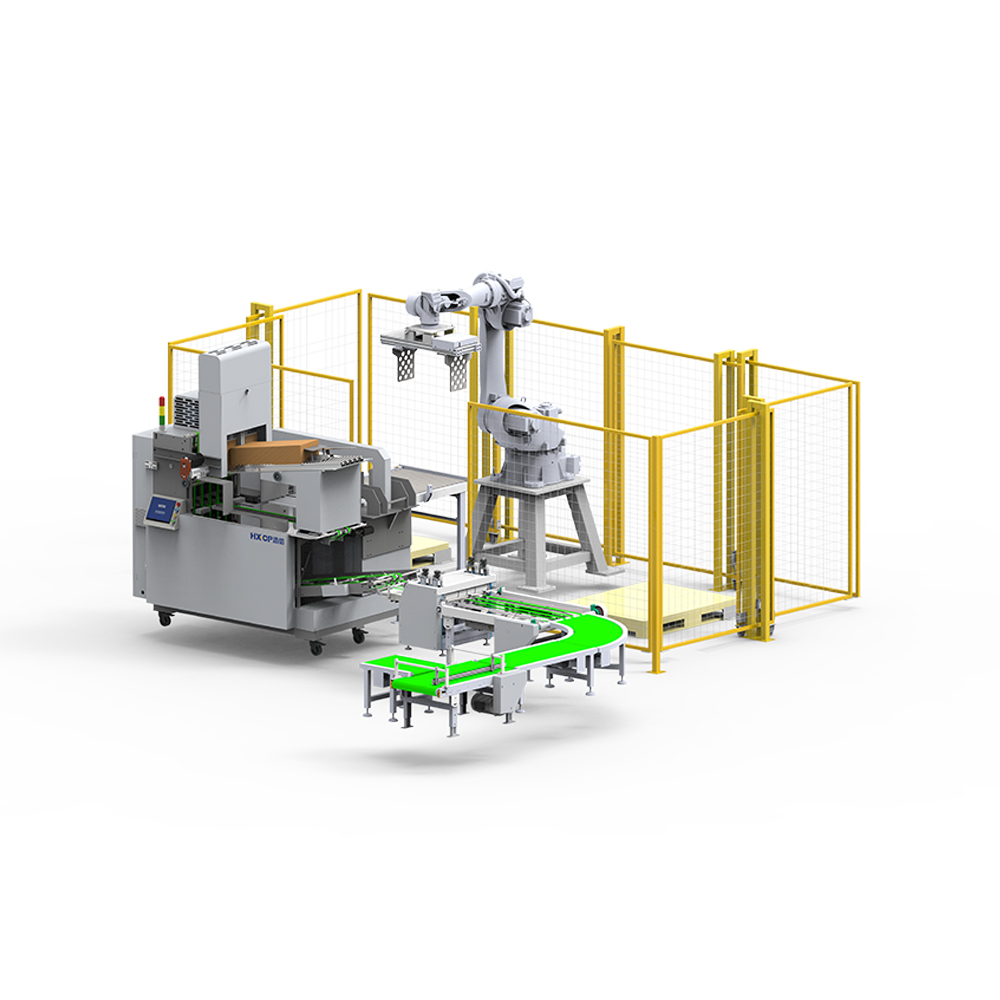 HX40000W Web Press Signatures Collecting Bundling Palletizing System