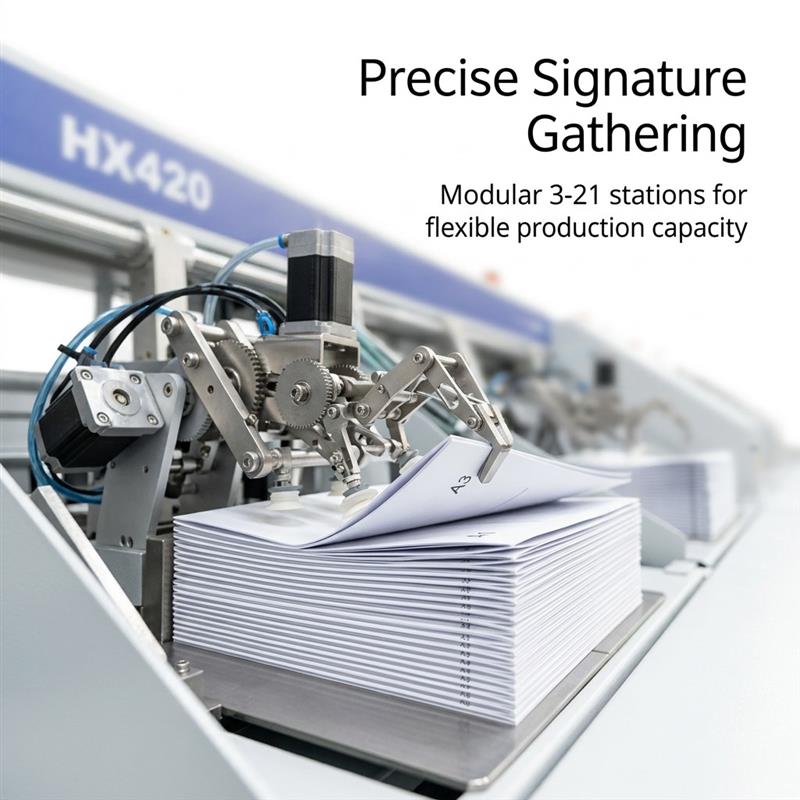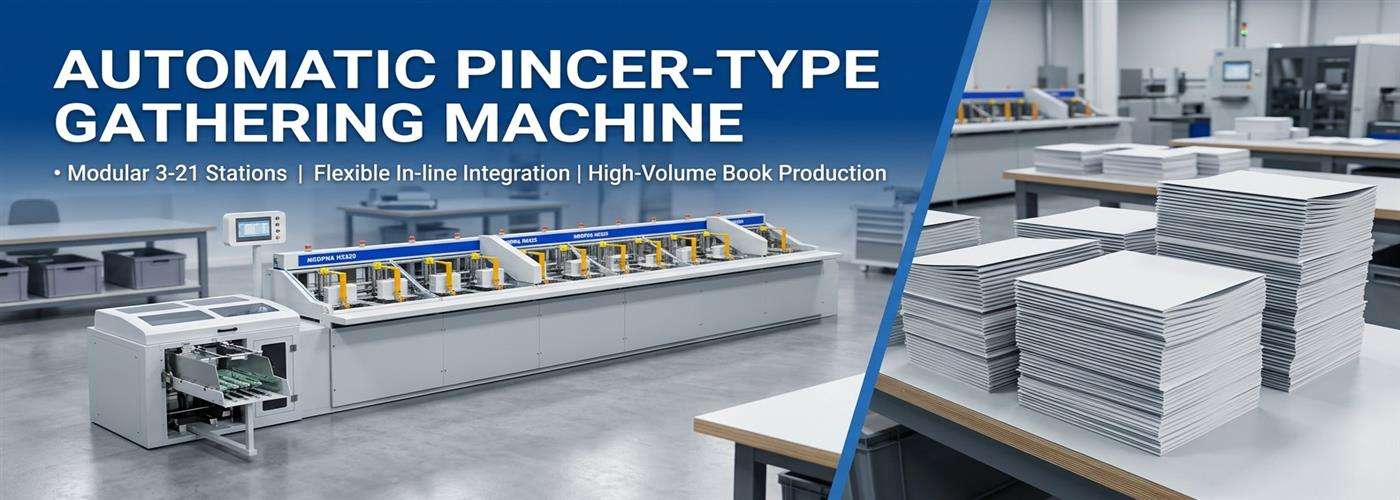
The HX420 Automatic Pincer-Type Gathering Machine is a fully automatic solution designed to collect and gather printed sheets or folded signatures in the correct sequence, assemble complete book blocks, and deliver them continuously for the next binding process.
|
Every growing bindery hits the same wall: production demand rises, but the gathering process cannot keep pace. Adding workers helps briefly, then the space runs out, the supervision load grows, and sequence errors creep up. The alternative is not a bigger version of the same manual process—it is a machine designed to grow with the facility. A Modular Gathering Machine changes the economics of scaling by converting a headcount-driven process into a capacity-driven one, and its modular architecture means the capacity grows in predictable increments as production demands it.
Why Gathering Is the Process That Caps Bindery GrowthThe gathering stage sits between printing and binding, and its capacity determines how much work can flow through the entire line. When gathering is manual, capacity is a function of headcount and floor space. Each additional gatherer needs space to walk the line, training to learn the signature sequence, and supervision to maintain accuracy. The scaling cost is linear and painful: doubling output requires roughly doubling the gathering team. Worse, manual gathering capacity does not scale smoothly. Adding the sixth worker to a line designed for five creates congestion, not throughput. The facility reaches a practical ceiling where additional workers add cost without adding output. This ceiling is invisible on the organization chart but real on the production floor, and it is the most common reason binderies hit a growth plateau while their binding equipment still has capacity to spare.
The Modular Architecture as a Growth StrategyThe HX420's modular design converts gathering capacity from a binary decision—buy a fixed-size machine or not—into a graduated investment path. Each module contains three gathering stations, and the machine is configurable from 3 to 21 stations in three-station increments. A facility starting with 6-station needs buys the 6-station configuration. When the product line expands or output grows, it adds modules to reach 9, 12, or more stations. The strategic value is that capital investment tracks production growth instead of anticipating it. The facility does not pay for 21 stations of capacity on day one when it needs only 6. It buys the capacity it needs now and expands when the demand exists to justify the expansion. This phased approach preserves working capital for other growth investments while keeping the gathering process ready to scale. Configuring Stations to Match Current and Future Product LinesThe station configuration must cover the facility's current maximum signature count with headroom for growth. If the thickest current product requires 8 signatures, the 9-station configuration provides one spare station. If the facility plans to expand into 12-signature books within the planning horizon, the 12-station configuration covers both current and planned products.
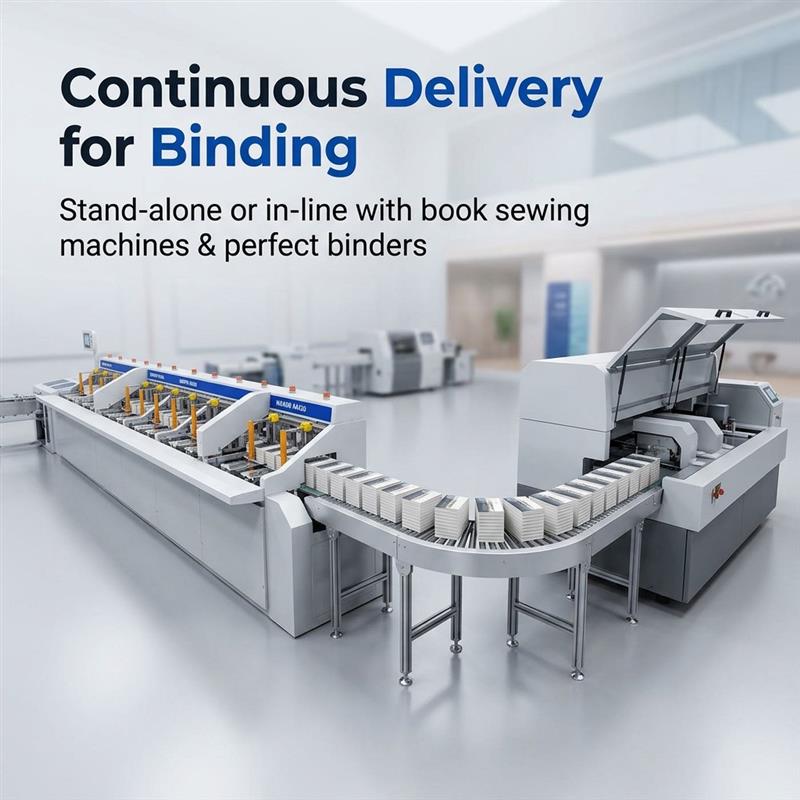
The headroom calculation should also account for signature size changes. A facility switching from 16-page signatures to 32-page signatures doubles the pages per signature, halving the stations needed for the same book—but the signature sizes will be larger, and the machine must handle the new dimensions. The HX420's signature envelope of 120 by 80mm to 400 by 280mm covers both standard and large signatures, so the station count, not the size range, is the growth constraint. Increasing Throughput Per Station ConfigurationStation count determines what books the machine can assemble; speed determines how many it can produce. The HX420 runs at up to 5,000 pieces per hour of signature throughput. The effective book output is throughput divided by signatures per book. A 10-signature book yields 500 books per hour; a 5-signature book yields 1,000. Scaling output, then, involves two levers. The first is station count, which determines the maximum signature count per book. The second is speed, which is fixed by the machine's 5,000 pieces per hour capability. For a facility whose product line is stable, output scales by adding modules to handle thicker books or by running additional shifts. For a facility whose product mix shifts toward thinner books, output increases without any configuration change. Integration with Sewing Machines and Perfect BindersGathering does not exist in isolation; it feeds a binding process. The HX420 connects inline with a book sewing machine or perfect binder, creating a continuous flow from gathered signatures to bound book blocks. Inline integration eliminates the transfer step between processes, removing handling labor and the misalignment risk that transfer introduces.
For scaling purposes, inline integration changes the capacity planning math. When the gatherer feeds the binder directly, the system's throughput is governed by the binder's speed, and the gatherer must keep pace. The HX420's 5,000 pieces per hour signature throughput comfortably feeds standard sewing machines and perfect binders. As the binder's output grows through upgrades, the gatherer's modular expansion keeps the system balanced. Factory Layout Flexibility for Growing FacilitiesFloor space is the constraint that appears late in growth planning. A facility that expands production often discovers its layout cannot accommodate the new equipment without reorganizing the entire floor. The HX420's compact design and two-sided loading capability mitigate this problem. Loading from either side means the machine positions flexibly—against a wall, in a corner, or centered in a line—without forcing the layout to accommodate a fixed loading side. The machine dimensions of 8,300 by 1,900 by 1,800mm are for the full 21-station configuration; smaller configurations occupy proportionally less space. When planning a facility expansion, the modular machine can be specified at the size that fits the current layout, with the understanding that modules can be added within the same footprint as the line grows. Utilities and Infrastructure Planning for Modular ExpansionAn automatic gathering machine requires modest utilities that most binderies already have. Power is 8kW on three-phase supply. Compressed air demand is 300 liters per minute at 0.6 bar—well within the capacity of standard bindery compressors. The 3,200kg machine weight requires a level industrial floor with adequate load capacity. The infrastructure planning should anticipate module additions. When a facility adds gathering modules, the additional stations increase the machine's length but not its power or air demand proportionally—the infrastructure is sized for the full configuration from the start. Planning the floor, power, and air for the ultimate configuration while buying only the current modules avoids rework during expansion. Phasing the Investment to Match Production GrowthThe modular gathering machine supports a disciplined investment approach. Year one: install the configuration covering the current product line with one module of headroom. Year two or three, as production grows: add modules funded by the labor savings the machine has already generated. This self-funding expansion model is the practical appeal of modular architecture. The alternative—buying the full configuration upfront—ties up capital in capacity that generates no return until production catches up. The phased approach keeps the capital working: each module addition is funded by the output growth it supports. For a growing bindery, this alignment of investment with demand is the difference between a machine that funds its own expansion and a machine that strains the balance sheet. Planning the Workforce TransitionScaling with automation changes the workforce structure. Manual gatherers are displaced by the machine, and facilities should plan this transition with care. The one supervising operator role—monitoring stations, refilling signatures, changing formats, checking quality—can be offered to the most experienced gatherers, converting a threatened position into an upgraded one. The machine's user-friendly operation and fast format changeover make the transition smooth. The workforce planning should also anticipate the shift in skill demand. Manual gathering requires physical speed and sequence memory; automated gathering requires monitoring, setup, and troubleshooting skills. Retraining experienced workers for the new role preserves institutional knowledge and morale. Facilities that manage this transition well report that the automation investment pays off in retention as well as production. The Scalability Decision in PerspectiveThe decision to scale with a modular gathering machine is fundamentally a decision about how the facility will grow. Manual gathering scales by adding people until space and supervision limits are reached. Automatic gathering scales by adding modules that increase capacity in predictable increments, funded by the savings the machine generates. The modular architecture of the HX420 makes the scaling path explicit: 3 to 21 stations, three at a time, matched to production demand. For a bindery whose growth plan extends beyond its current output, the modular gathering machine is not just equipment—it is the growth infrastructure. It converts gathering from a bottleneck that caps the facility to a capacity that grows on demand. |
| Tag:Automatic Gathering Machine,Pincer-Type Gathering Machine,Book Signature Gathering Machine,Bookbinding Gathering Machine |
Please Leave Your Messenger Here!
We will do our best to make your business prosperous!


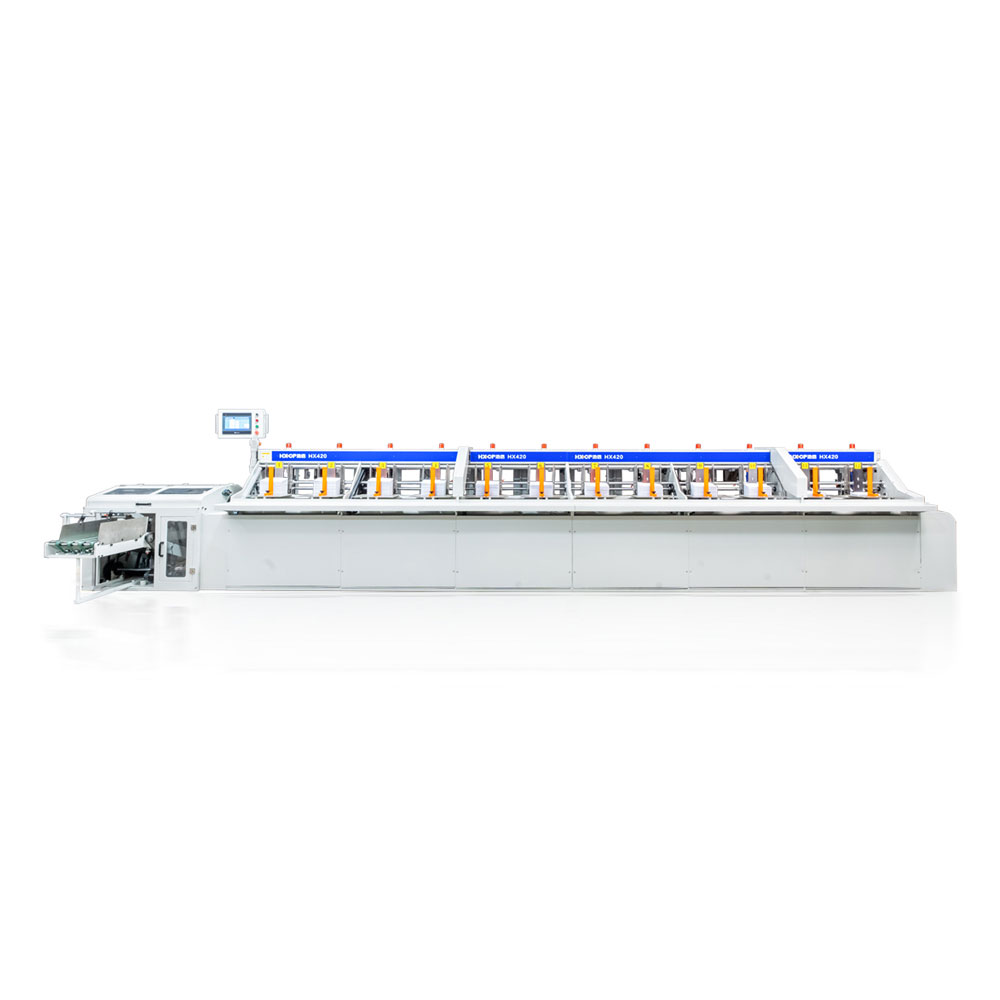 HX420 Automatic Pincer Type Gathering Machine