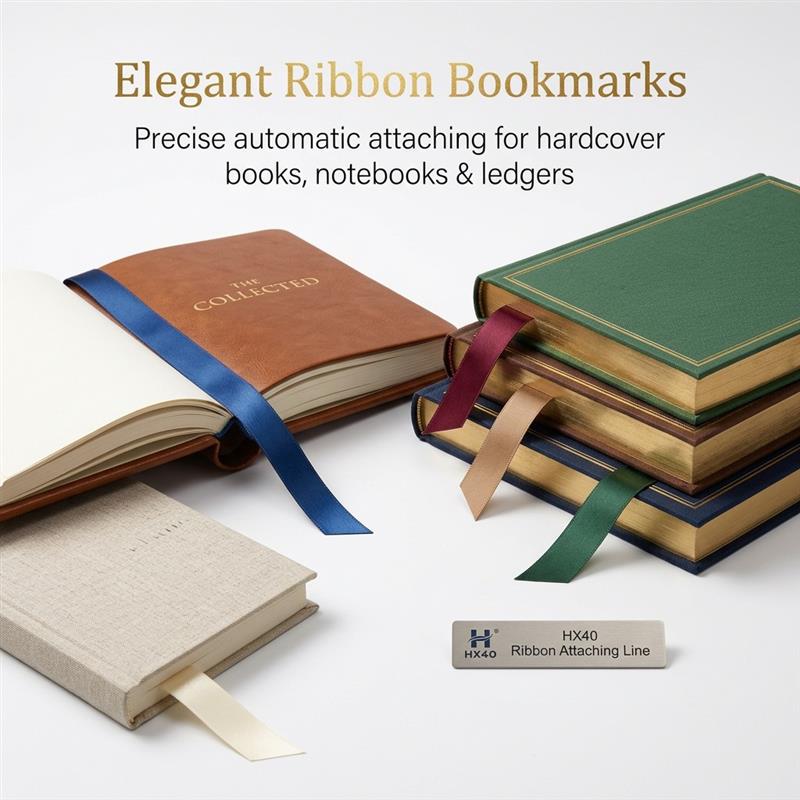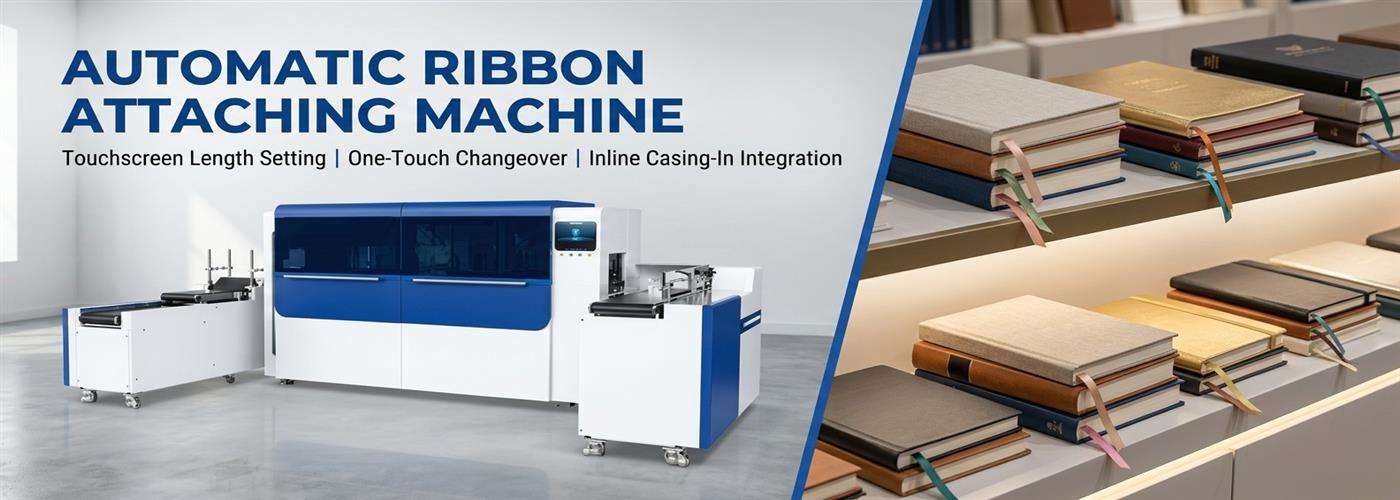
The HX40 Automatic Ribbon Attaching Machine is designed for automatically attaching bookmark ribbons to hardcover books, notebooks, ledgers, and similar products. It integrates automatic book feeding, ribbon cutting and heat sealing, ribbon gluing, tail folding, book delivery, and stacking into one efficient process.
|
A bookmark ribbon is the first thing a customer touches when they open a premium book. If that ribbon is frayed at the end, or shedding threads, or coming apart after a few weeks of use, the impression of quality evaporates. Yet most ribbon attaching operations treat the ribbon end as an afterthought—a straight cut, a quick glue, a fold, and done. The difference between an ordinary ribbon attachment and a premium one is how the ribbon end is finished. That is where heat sealing comes in, and it is the feature that separates a Ribbon Attaching Machine built for premium production from one built to a price.
Why Ribbon Ends Fray and Why It Ruins the Book ExperienceBookmark ribbons are woven textile material—satin, grosgrain, or polyester webbing—and like all woven materials, they unravel at any cut edge. When a ribbon is cut with a mechanical blade, the cut interrupts the weave at the end, and the individual warp and weft threads are left loose. Over the book's life, every tug on the ribbon pulls these loose threads further, creating a frayed, fuzzy end that sheds lint and looks worn. On a premium hardcover that costs the customer thirty dollars or more, a fraying ribbon is a visible defect that undermines the product. Manual operations often make the problem worse. A worker cutting ribbons with scissors or a knife creates ragged edges with every cut, and the loose threads accumulate in the gluing station, causing misalignment on subsequent books. Some operations try to mitigate fraying with adhesive—dipping the cut end in glue to bind the threads—but this adds a process step, creates glue buildup, and produces an uneven, lumpy ribbon end that looks worse than the problem it solves.
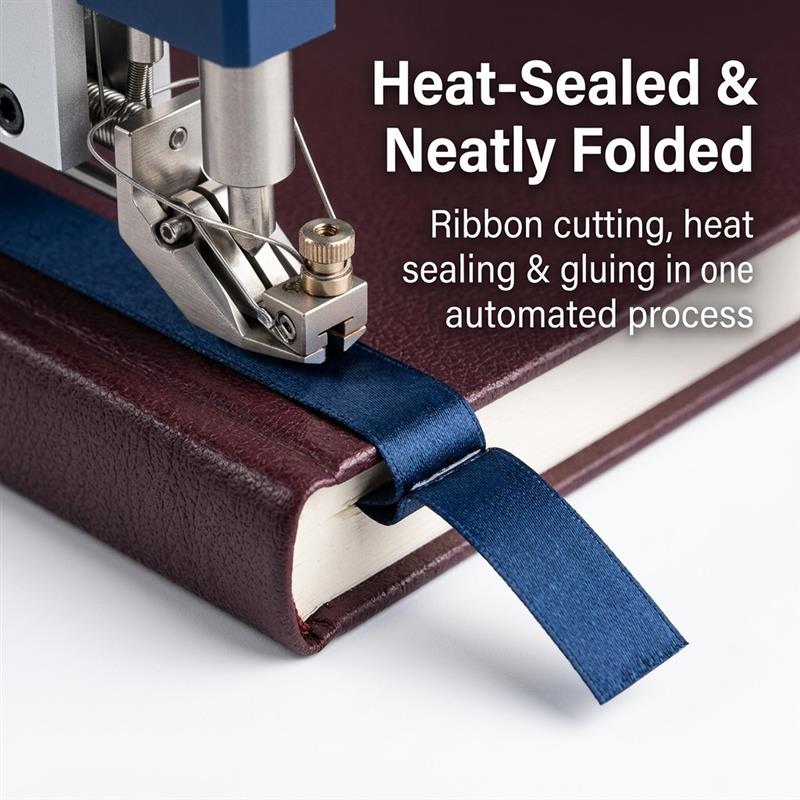
How Heat Sealing Solves the Fraying Problem at the SourceHeat sealing addresses fraying at the moment of cutting. Instead of a mechanical blade that separates the weave, the machine uses a heated element that cuts and seals simultaneously. The heat melts the synthetic fibers at the cut line—most bookmark ribbons contain polyester or nylon, which melt rather than burn at the right temperature—and fuses them into a clean, solid edge. The fused end cannot unravel because there are no loose threads to pull. The result is a ribbon end that is smooth, clean, and permanently sealed. It does not shed lint. It does not fray with use. It survives years of tugging in a book that is opened and closed regularly. For premium products, this is not a minor aesthetic detail; it is the difference between a ribbon that looks new after a year and one that looks worn after a month. The HX40 integrates this heat sealing directly into the automated process. The machine cuts each ribbon to the programmed length and seals the end in the same operation, then moves it through gluing, attaching, and tail folding. The operator never handles a cut ribbon, never applies edge adhesive, and never inspects for loose threads. The sealed end is produced consistently on every ribbon, every book. The Quality Standard Difference Between Cut Ends and Sealed EndsTo appreciate heat sealing, compare two ribbons side by side. One has a mechanically cut end; the other has a heat-sealed end. The cut end shows individual threads at the edge, catches under a fingernail, and pulls loose with a gentle tug. The sealed end is smooth and solid, with a slightly melted, glossy edge that does not catch or pull. Under a magnifying glass the difference is unmistakable; in the customer's hand it is felt immediately.
For publishers and stationery brands that inspect samples before ordering, the sealed end is a selling point. A brand manager opening a sample notebook and running a finger along the ribbon end notices the difference instantly. The heat-sealed ribbon signals manufacturing care, and in premium markets, perceived quality determines price. Facilities that produce heat-sealed ribbons can command the premium price; facilities that produce frayed ribbons are limited to commodity segments. How Heat Sealing Fits Into the Automated Attaching ProcessHeat sealing is not a standalone step; it is integrated into the ribbon attaching workflow. The HX40's process runs: automatic book feeding, ribbon cutting with heat sealing, ribbon gluing, tail folding, book delivery, and stacking. The heat-sealed ribbon is glued to the book block at the correct position, and the tail is folded neatly inside the book. The sealed end is the finished ribbon end the customer sees; the glued end is hidden inside the spine. Because the machine cuts, seals, glues, and attaches in one pass, there is no separate ribbon preparation step and no work-in-progress inventory of pre-cut ribbons. The ribbon reel loads into the machine, and finished books emerge with correctly attached, heat-sealed ribbons at 20 to 40 books per minute. Matching the Heat Sealing Process to Your Ribbon MaterialsHeat sealing is not universal across all ribbon materials, which is why the machine's ribbon width range and temperature control matter. The HX40 handles ribbons from 3 to 13mm wide, covering narrow marker ribbons through wide decorative styles. The heat element must be tuned for the ribbon material in use: satin ribbons need different temperature and dwell time than grosgrain or polyester webbing.
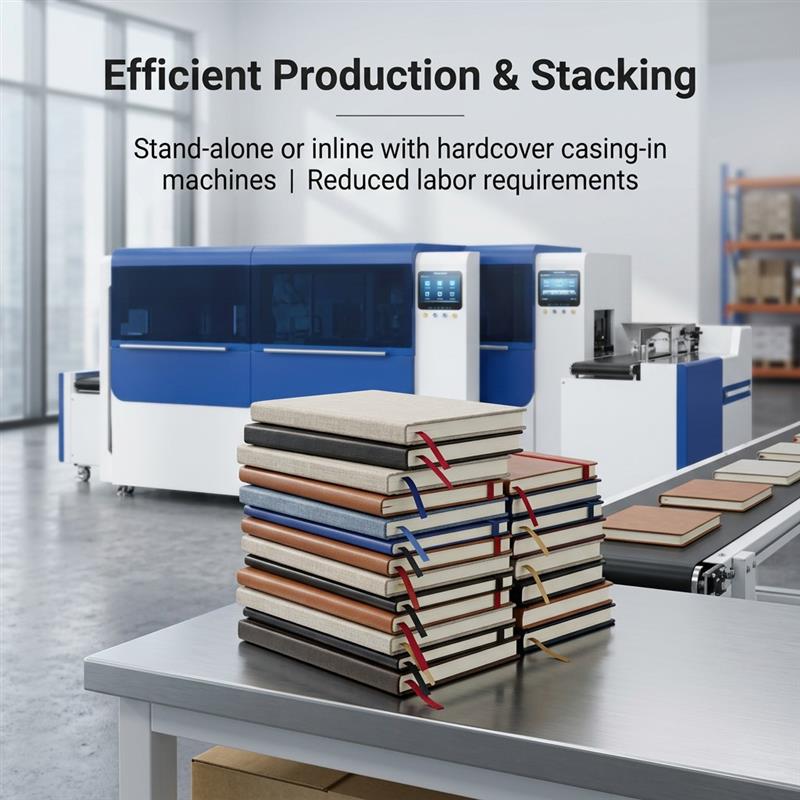
Ask the supplier how the heat sealing is adjusted for different ribbon materials and widths. The right approach is programmable temperature and sealing time settings per ribbon type, stored as presets for instant recall. A machine with a fixed heat setting works only for one material; a machine with adjustable settings covers the full ribbon range a facility uses. Before purchase, run test seals on your actual ribbon stock and check the sealed edge quality under magnification. The Book Handling Range That Determines Practical UseBeyond the ribbon mechanism, the machine must handle the facility's books. The HX40 processes book thicknesses from 4 to 60mm and sizes from 85 by 100mm to 240 by 300mm—the full hardcover spectrum from thin gift books to thick ledgers. The book feeding and tail folding mechanisms must work reliably across this range, because a ribbon attaching machine that jams on thin books or misaligns tails on thick books is not a solution. The tail folding step deserves particular scrutiny. The tail—the portion of the ribbon that lies inside the book—must be folded cleanly so the book closes flat and the ribbon lies smoothly along the spine. Verify the tail folding quality on your thinnest and thickest products before purchase. Standalone and Inline Operation for Flexible ProductionThe HX40 operates in two modes. As a standalone unit, it receives books from a pallet or conveyor and delivers finished books with attached ribbons to the next process—suited to facilities that attach ribbons in a separate production stage. As an inline unit, it connects directly to hardcover casing-in machines, so books flow from casing-in into the ribbon machine without intermediate handling. Inline operation eliminates transfer labor and handling risk, and it ensures the ribbon step never falls behind the casing-in machine's output. Installation Requirements for a Focused Single Purpose MachineThe HX40's utility requirements are modest, reflecting its focused single-purpose design. It draws 7kW on three-phase 380V—about half the power of a combined ribbon-and-headband line—and requires 6 Bar compressed air, standard for bindery equipment. At 1,450kg, the machine is light enough to install on a standard industrial floor without reinforcement and flexible enough to reposition within an evolving production line, which simplifies layout changes as production scales. Installation planning should account for the machine's footprint, access for the book feeding and delivery zones, and space for the touchscreen console. Most installations complete within a week, including commissioning and operator training. The Quality Investment That Protects Premium PricingA heat-sealing ribbon attaching machine is a quality investment, not just a labor investment. The heat-sealed ribbon end is a visible marker of manufacturing quality that customers feel the moment they open the book. For facilities supplying premium publishers and stationery brands, the sealed edge supports the premium pricing those markets command. The machine's consistent, automated process—cutting, sealing, gluing, folding, and stacking at 20 to 40 books per minute—replaces the variability of handwork with mechanical repeatability, on every book, every shift. The decision to buy a ribbon attaching machine with heat sealing is ultimately a decision about what quality level the facility wants to be known for. A machine that cuts ribbons without sealing produces books with fraying ribbons and limits the facility to commodity pricing. A machine that seals as it cuts produces books that feel premium in the customer's hand. In a market where the ribbon is the first thing touched, the choice is visible in every book. |
| Tag:Automatic Ribbon Attaching Machine,Bookmark Ribbon Inserting Machine,Hardcover Book Ribbon Machine,Automatic Ribbon Gluing Machine |
Please Leave Your Messenger Here!
We will do our best to make your business prosperous!


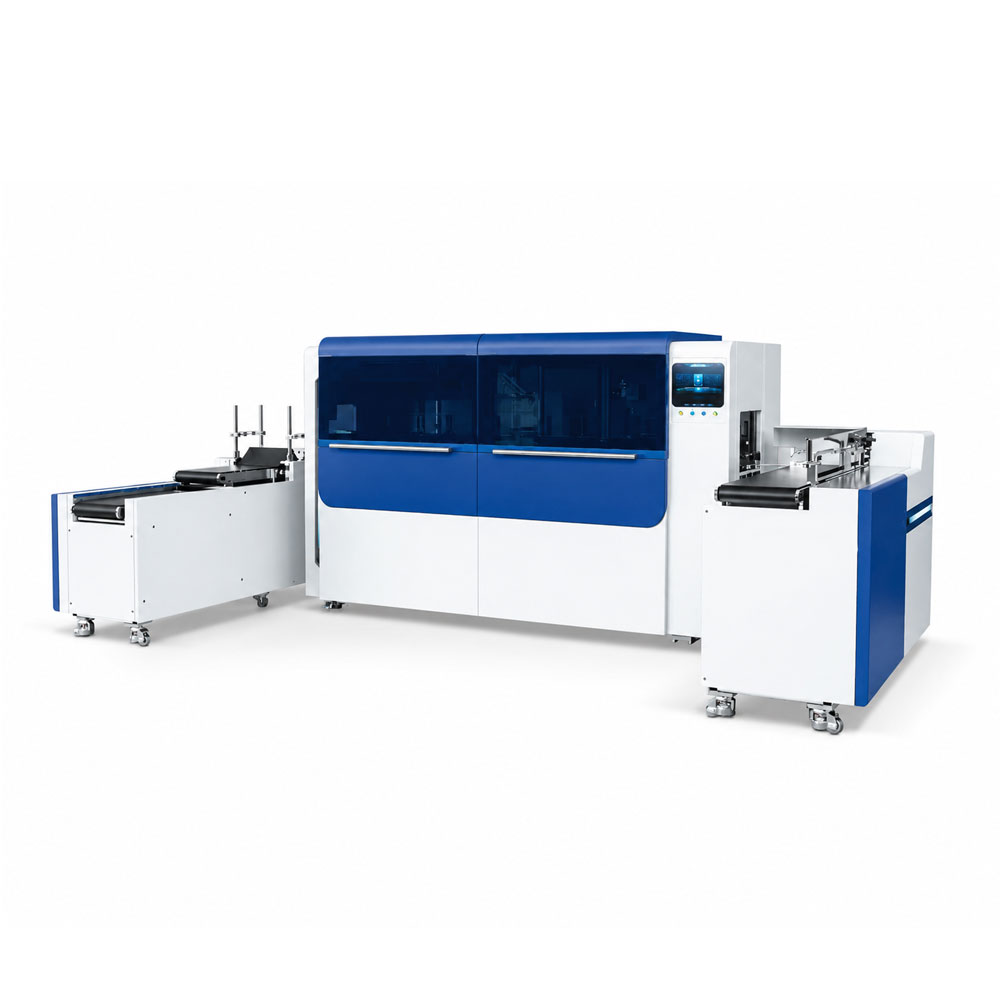 HX40 Automatic Ribbon Attaching Machine